







Bypassing the Anxious Mind to Regulate the Nervous System
If you or someone you love is struggling with severe anxiety, treatment-resistant depression, or trauma, you likely know the frustration of traditional therapies. When the nervous system is locked in a state of high alert, simply “talking about it” can sometimes feel impossible or even triggering. At Arbor Wellness in Brentwood, Tennessee, we recognize that true healing requires innovative approaches that address the mind-body connection at a neurobiological level.
We have integrated the science of Biosound Therapy into our residential treatment program as a cornerstone intervention. In a city built on the power of music, it is fitting that one of the most sophisticated clinical tools we offer utilizes sound frequency, vibroacoustic massage, and biofeedback to facilitate profound healing.
Learn the science behind Biosound therapy and how it actively rewires the brain to support mental health recovery.
How Do Sound and Vibration Affect the Brain?
The brain operates through electrical activity organized into distinct frequency patterns known as brainwaves. These patterns correspond to different states of consciousness and emotional regulation.
- Beta Waves: Active, analytical thinking. In individuals with anxiety, the brain is often stuck in high-frequency “high beta” states (hyper-arousal).
- Alpha Waves: Calm, relaxed awareness.
- Theta Waves: Deep relaxation, meditation, and the state right before sleep, where emotional processing occurs.
Biosound therapy utilizes binaural beats—playing slightly different sound frequencies in each ear. The brain compensates by creating a third frequency, effectively “entraining” the brainwaves to slow down from a stressed Beta state into a restorative Alpha or Theta state.
How Biosound Therapy Calms Severe Anxiety
Anxiety disorders are one of the most common conditions we treat at Arbor Wellness. Neurobiologically, anxiety involves a hyperactive amygdala (the brain’s threat-detection center) and an underactive prefrontal cortex (the rational, regulating center).
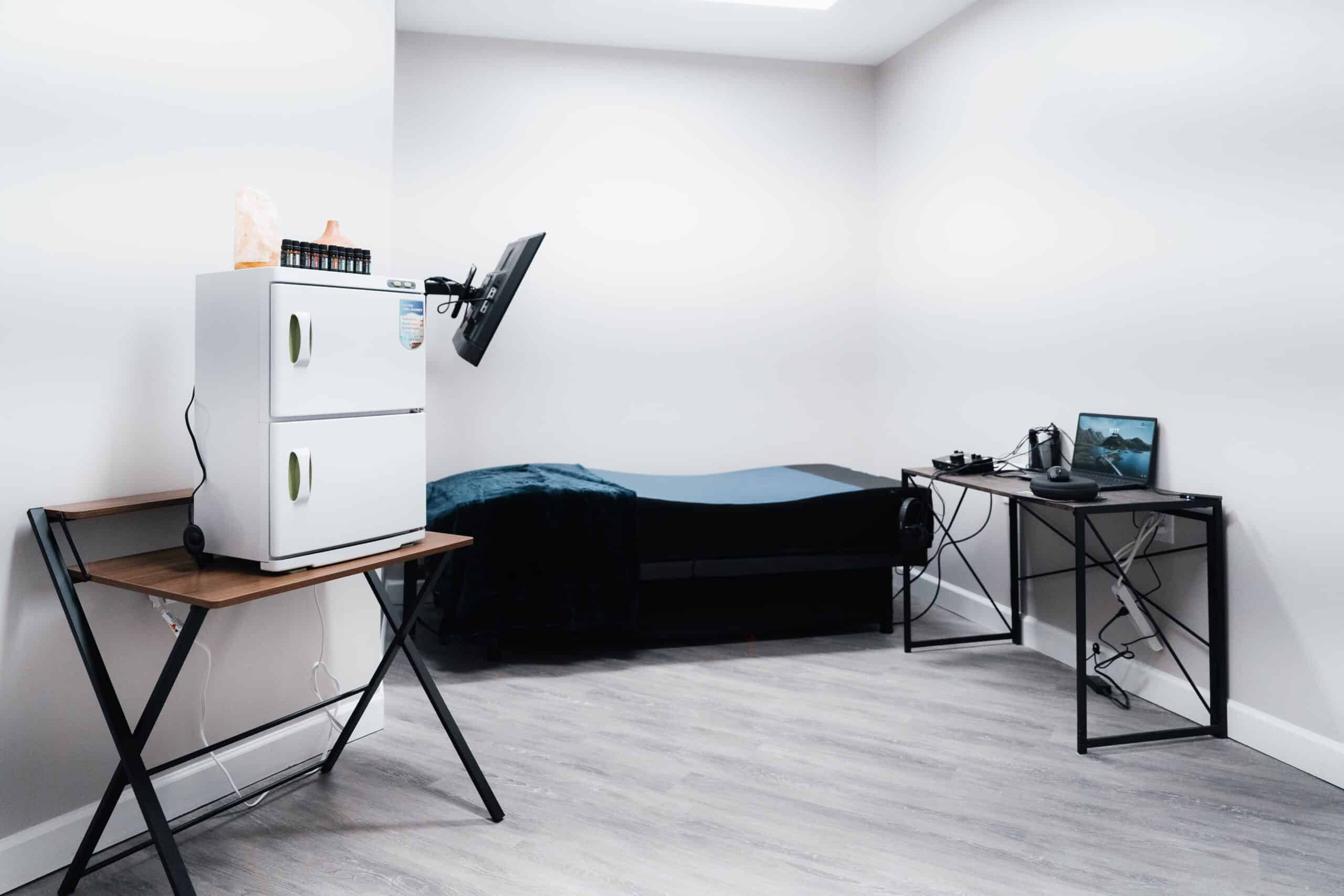
Biosound therapy directly interrupts this pattern. The client lies on a specialized bed that delivers low-frequency vibrations synchronized with soothing music. This vibroacoustic stimulation triggers a rapid parasympathetic nervous system response—the body’s “rest and digest” mode. By physically regulating the body (lowering heart rate and muscle tension), the brain is forced to register safety. It silences the amygdala’s alarm bells.
The advantage of Biosound therapy is that it works alongside talk therapy. While Cognitive Behavioral Therapy (CBT) addresses the cognitive dimensions of anxiety, Biosound therapy regulates the body’s alarm system, making the client receptive to cognitive work.
Biosound Therapy for PTSD and Complex Trauma
Trauma survivors often experience severe dysregulation; their bodies perceive danger even when objectively safe in our Brentwood facility. Many trauma survivors have difficulty with traditional talk-based therapies initially because discussing the trauma immediately reactivates their nervous system.
Biosound therapy is highly effective for PTSD because it facilitates regulation without requiring explicit verbal processing. The vibroacoustic stimulus creates what neuroscientists call “vagal rebound”—stimulating the vagus nerve to essentially “reset” the dysregulated trauma response.
Furthermore, the biofeedback component of the Biosound system allows clients to monitor their heart rate variability on a screen, teaching them to consciously master their physiological responses to stress.
Integration with Our Comprehensive Treatment Approach
While Biosound therapy is powerful, it is not a standalone “spa” treatment. At Arbor Wellness, it is a clinical intervention integrated thoughtfully into our residential treatment protocols.
We schedule Biosound sessions strategically. For example, a client may utilize the Biosound bed in the morning to calm their nervous system, preparing them to engage deeply in an intensive trauma-processing therapy session later in the day.
Alternatively, it may be used in the evening to help a client process the difficult emotions brought up during group therapy, ensuring they can achieve restorative sleep. This combination of targeted trauma therapy and advanced nervous system regulation produces durable improvements in baseline anxiety and emotional stability.
Experience the Frequency of Healing
At Arbor Wellness, we do not believe in cookie-cutter treatment. Biosound therapy is just one of the advanced, evidence-based tools we use to tailor a recovery plan to your unique neurobiology.
If you are ready to experience the power of integrated, technology-assisted mental health treatment, contact our admissions team today. Take the first step toward lasting healing and renewed peace of mind in Nashville.
Frequently Asked Questions About The Science of Biosound Therapy
How many Biosound therapy sessions do I need to see results?
Most clients report immediate physical relief and a reduction in acute anxiety after a single session. However, optimal, long-lasting neuroplastic changes typically emerge after 8 to 12 sessions within a comprehensive residential treatment program.
Can Biosound therapy replace my psychiatric medication?
No. Biosound therapy is a powerful complementary modality, but it does not replace the need for medication in many conditions (like Bipolar Disorder or severe clinical depression). Our psychiatrists use it synergistically alongside medication management.
What is the difference between Biosound therapy and just listening to a meditation app?
Biosound is a clinical intervention. It combines specific binaural beat frequencies to entrain brainwaves, physical vibroacoustic stimulation delivered through a specialized bed to activate the vagus nerve, and live biofeedback to train physiological control—creating a much more profound biological shift than audio alone.
Sources
- Braun Janzen, T., et al. (2024). Effects of vibroacoustic stimulation on psychological, physiological, and cognitive stress. Frontiers in Psychology. Retrieved from: https://pubmed.ncbi.nlm.nih.gov/39338668/. Accessed on February 27, 2026.
- Ingendoh, R. M., et al. (2023). Binaural beats to entrain the brain? A systematic review of the effects of binaural beat stimulation on brain oscillatory activity. PLOS ONE. Retrieved from: https://journals.plos.org/plosone/article?id=10.1371/journal.pone.0286023. Accessed on February 27, 2026.
- Kantor, J., et al. (2022). Effect of low frequency sound vibration on acute stress response—Pilot randomized controlled trial. PLOS ONE. Retrieved from: https://pmc.ncbi.nlm.nih.gov/articles/PMC9606670/. Accessed on February 27, 2026.


